
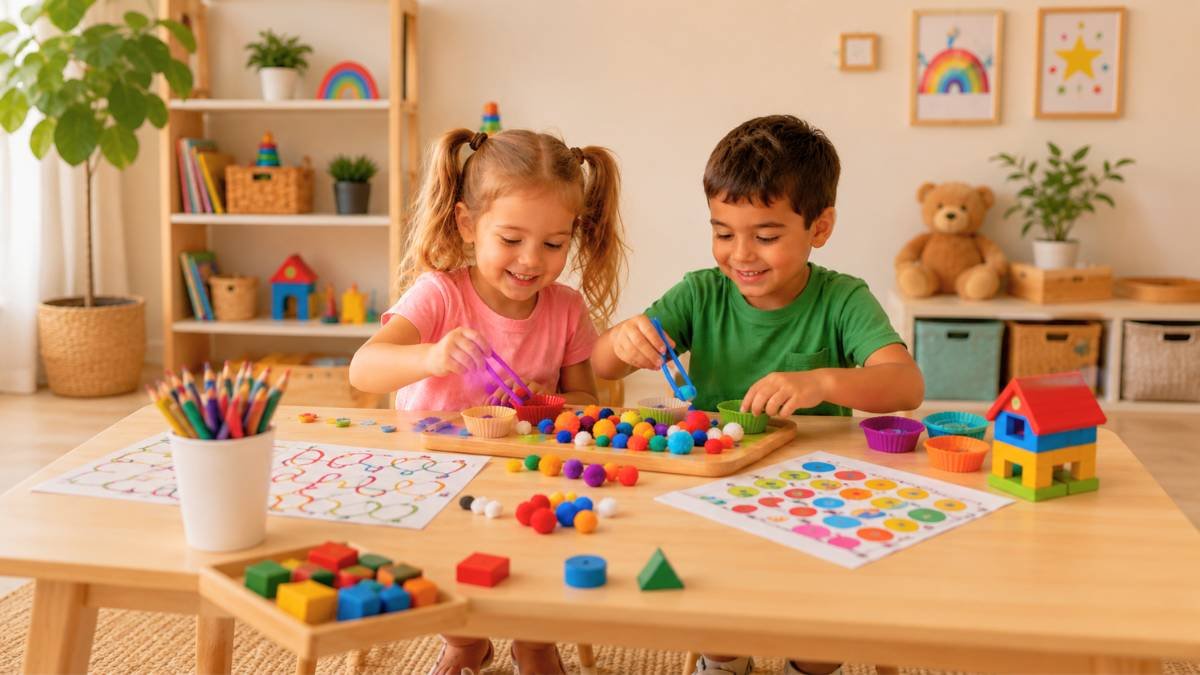
Looking for the best fine motor activities for toddlers? You're in the right place! If your toddler struggles to hold a crayon, button a shirt, or pick up small objects — you're not alone. Fine motor skills take time and practice, but the good news is: you don't need fancy toys or expensive programs to help your child develop them.
In this post, you'll find 10 easy fine motor activities for toddlers that you can start today, using things you likely already have at home. And stick around — there's a free printable fine motor worksheet at the end!
What Are Fine Motor Skills in Toddlers?
Fine motor skills involve the small muscles in the hands, fingers, and wrists. These muscles control everyday tasks like writing, drawing, cutting with scissors, buttoning clothes, and using a fork. Practicing fine motor activities for toddlers early is essential for school readiness and daily independence.
💡Did You Know?
Research shows that children who develop strong fine motor skills in preschool tend to perform better in reading and math throughout elementary school. Small hand movements and brain development are deeply connected!
10 Best Fine Motor Activities for Toddlers at Home
1 ✏️ Tracing
Tracing Worksheets
Tracing lines, shapes, and letters is one of the best ways to build pencil control. Start with thick, simple lines and gradually move to curves and zigzags. Our printable tracing worksheets are designed specifically for little hands just learning to grip a pencil.
2✂️Cutting
Cutting with Safety Scissors
Give your toddler child-safe scissors and strips of paper to snip. This builds hand strength and bilateral coordination. Start with straight lines, then move to curves and shapes as they improve.
3🫙 Squeezing
Playdough Squeezing and Rolling
Playdough is a classic for a reason! Squeezing, rolling, and pinching dough strengthens the exact muscles toddlers need for writing. Make simple shapes together — they won't even know it's exercise.
4 🧵Threading
Bead Threading and Lacing
Threading large beads onto a string requires focus, pincer grip, and hand-eye coordination all at once. You can buy lacing cards or make your own from cardboard with a hole punch.
5🖌 Painting
Finger Painting and Brush Painting
Painting develops hand control and creativity simultaneously. Finger painting is great for sensory development, while paintbrush work builds the tripod grip needed for writing.
6 🧩 Building
LEGO and Block Building
Pressing, connecting, and pulling apart LEGO bricks requires significant finger strength. Even simple stacking blocks help toddlers develop grip and spatial awareness.
7 🪙 Sorting
Coin or Button Sorting
Sorting small objects into containers using a pincer grip is a wonderful free fine motor activity. Use coins, dried beans, or buttons sorted by color into a muffin tin. Always supervise toddlers with small objects
8 🖍 Drawing
Dot-to-Dot and Coloring Pages
Dot-to-dot activities encourage pencil control and number recognition at the same time. Coloring within lines develops precision and focus. Use thick crayons for younger toddlers.
9 🧶 Pom-Pom Transfer
Pom-Pom Fine Motor Activity
Using pom-poms and tongs is a fun way to strengthen hand muscles and improve coordination. Ask your toddler to pick up colorful pom-poms and move them from one bowl to another. This simple activity helps develop the pincer grasp needed for writing, buttoning clothes, and other everyday skills.
10 📌 Stickers
Sticker Peeling and Placing
Peeling stickers from a sheet requires a precise pincer grip and is wonderfully satisfying for toddlers. Give them a sticker sheet and a blank piece of paper and let them create freely. Simple and effective!
⏱ How Long Should Practice Sessions Be?
For toddlers ages 2–3, aim for 5–10 minutes per activity. For ages 4–5, up to 15–20 minutes is great. Short, frequent practice is far more effective than long sessions. Follow your child's lead!
Ready-Made Fine Motor Worksheets
Save time with our beautifully designed printable worksheets — tracing, cutting guides, matching, and more. Instant PDF download, print at home!
Browse Worksheets →FAQs About Fine Motor Activities for Toddlers
At what age should toddlers start fine motor activities?
Structured activities like tracing, cutting, and threading are most appropriate starting around age 2–3, when children have enough hand control to benefit from focused practice.
How do I know if my toddler has fine motor delays?
Signs include difficulty holding a crayon by age 3, trouble stacking blocks, or avoiding activities that require hand control. If concerned, speak with your pediatrician or an occupational therapist.
Are printable worksheets good for fine motor development?
Yes! Tracing, dot-to-dot, and coloring worksheets are excellent tools for developing pencil grip and hand-eye coordination, especially when paired with hands-on activities like playdough and cutting.
What is the best fine motor activity for a 2-year-old?
For 2-year-olds, the best activities are playdough, sticker peeling, and large bead threading. These build foundational hand strength needed for later writing tasks.
Start Small, See Big Results
Fine motor skills don't develop overnight — but with just a few minutes of fun practice each day, you'll be amazed at how quickly your toddler progresses.
Don't forget to grab your free fine motor printable worksheet— it's the perfect companion to the activities in this post!